 Arriving
 Multimedia
 Contact

 Hrvatski
 Deutsch
 Italiano


Description of the Michele Shipwreck Snorkeling Site
About the Snorkeling Site
Long ago, before the invention of printing, maps of the Adriatic were drawn by hand and were known as portolans or isolarii. Dugi Otok was already marked on old Adriatic maps in the 14th century, but the Illyrians, skilled seafarers, knew about the island long before that, as evidenced by the remains of their hillforts on prominent heights. Even today, ask any sailor where the highest lighthouse in the Adriatic is located, and they will know it is Veli Rat on Dugi Otok! And it is precisely near the lighthouse, beside two rocky islets, that you will find a unique snorkeling site – a real treat for snorkeling enthusiasts: a cargo ship wreck resting in shallow water.
The residents of Veli Rat remember the unfortunate incident from 1983, as they helped the ship's crew reach safety and, fortunately, no one was injured. There are stories that the ship was deliberately run aground so that its owner at the time could collect money from the insurance company, but the truth was never uncovered.
The Shipwreck in Shallow Water
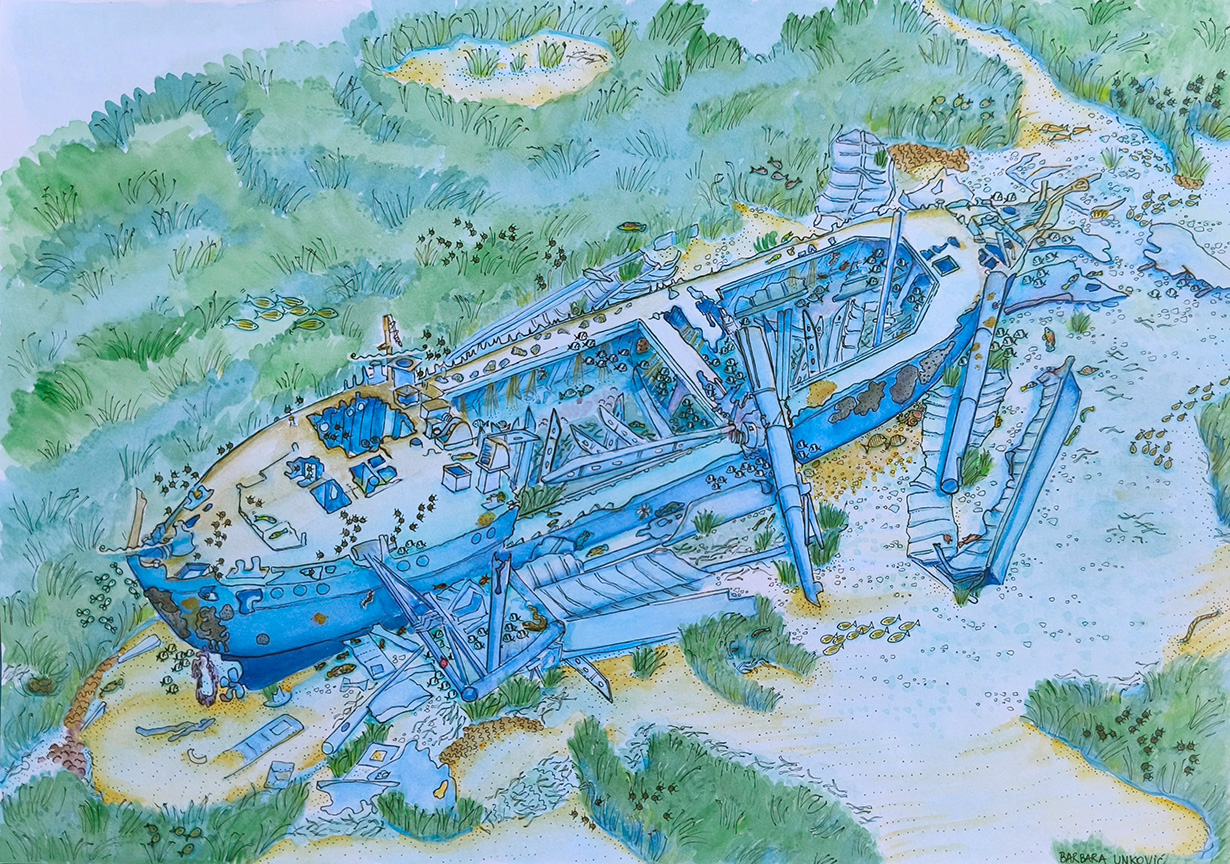
Today, the Michele lies on a shallow sandy seabed surrounded by meadows of the marine flowering plant Posidonia and is home to many marine inhabitants that have found safe shelter within it.
The ship is quite long and wide, with an open cargo hold running along almost its entire length, offering a unique experience for every visitor. Sunken ships usually rest at greater depths, quietly waiting for scuba divers, much like museums with limited visiting hours. The Michele wreck, however, feels alive, bathed in sunlight and immersed in the soundscape of the crackling sea... while its marine inhabitants communicate with one another in the language of the sea.
Fall in Love with the Adriatic
To fully immerse yourself in the beauty of this snorkeling site, take a moment to slow down and relax. You are surrounded by a rare and fascinating landscape. To the west, you can see the lighthouse, with the open sea stretching beyond it all the way to Italy. To the north, you can see islands and islets almost as far as the Kvarner Bay, while to the east, in the distance, Croatia's highest mountain, Velebit, rises above the horizon.
Arriving at the wreck from the village of Veli Rat or the nearby hamlet of Verunić is particularly beautiful, as the shallow Pantera Bay is adorned with an incredible shade of turquoise.
Sea currents flow around the wreck, bringing a constant supply of fresh seawater and creating excellent visibility.
Fascinating Underwater Residents
This wreck is home to large schools of monkfish that hide beneath the decks, stern and fallen masts. They are constantly on the move as visitors chase them like shepherds. You will easily recognize them by two distinctive black stripes: one behind the head, resembling a monk's collar, from which they get their name, and the other at the base of the tail.
He or She
At the stern, you can observe the most colorful resident of the wreck up close: the ornate wrasse (lat. Thalassoma pavo). This little fish looks as if it were at a masquerade ball! It is adorned with vibrant colors and can be recognized by its bright green body and colorful head. When it is male, it has only one transverse blue stripe, while females have several. This fish gradually changes from female into male. This is why it can display different colors and patterns depending on the stage of its transformation. It is fascinating to watch because of its lively swimming style, and it also fiercely defends its territory. At night, it buries itself in the sand and sleeps there. Females and younger individuals regularly clean other fish.
Caring Fathers
At this wreck, you have the opportunity to observe a fascinating little fish. It usually remains motionless in a shady spot. This is the cardinalfish (lat. Apogon imberbis), recognizable by its reddish-orange color and large black eye. Its color is actually excellent camouflage because, at depths greater than 5 metres, red light is no longer visible due to the physical properties of seawater. The cardinalfish therefore becomes inconspicuously grey, just like your red diving suit when you descend to greater depths. It is a caring father because it keeps the fertilized eggs in its mouth until the young fish develop.
But there are more caring fathers here! The male ocellated wrasse (lat. Symphodus ocellatus) builds a sea nest that resembles a bird's nest. It is a small fish, only about 10 centimetres long, recognizable by its greenish color and a gill spot bordered by red and turquoise. It has a black spot at the base of its tail. The females are brownish and constantly dart into his nest, as if checking how sturdy the weaving is.
He works hard all day building his home. He often carries small branches of algae in his mouth. If you follow him, he will lead you to his nest. He fiercely defends his home and his young.
Interesting Encounters
This wreck is also visited by moray eels (lat. Muraena helena). They look like snakes with their mouths open. They are brownish in color with a marbled pattern and are nocturnal hunters. Do not be frightened by their appearance, as they are not aggressive, but they may bite if disturbed. Here you can also see young groupers hiding beneath the ship's hull among the remains of the scattered superstructure. You will recognize them by their thick lips and brownish color covered with yellow spots. Interestingly, once a grouper notices you, it follows your every movement.
Large schools of damselfish (lat. Chromis chromis) are playing hide-and-seek everywhere. If you look closely, you will see that they resemble the coral reef fish of tropical seas. In fact, they are their only relatives in the Mediterranean.
Flowering Meadows
At this site, you can enjoy views of the most significant marine flowering plant, better known as Posidonia, which takes its name from the Greek god of the sea, Poseidon. Here, its meadows are extensive and form one of the most important ecosystems in the Mediterranean. They are considered “oxygen factories” and provide shelter, feeding grounds and nurseries for many marine animals. They can live for more than 1,000 years!
Watching them rhythmically sway with the waves or marine currents is deeply relaxing and almost hypnotic. The surrounding area teems with small fish such as damselfish, saddled seabream, saddled bream, comber and brown wrasse, while young white seabream can also be spotted. Schools of salema graze everywhere, while large salema swim through the cargo holds.
Our Relationship with the Sea
The sea is our ancestral environment and has always sustained us; for many, it is a livelihood and a source of endless inspiration. Do not forget that this wreck is a trace of someone's negligence, which the sea embraced and transformed into an artificial reef that is slowly being consumed by corrosion... Unfortunately, we rarely stop to think that pristine nature is the most valuable treasure we have and that we are passing it on to the generations that come after us.
Do not forget to check the weather forecast before setting out, as the best snorkeling is enjoyed in calm seas and always in company. Carefully assess your own breath-hold diving abilities when exploring the wreck, as poor self-assessment can result in scrapes and scratches.